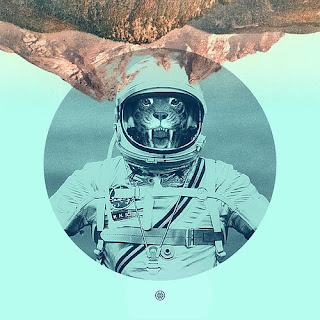
With all our talk of Discoveries, explorations, and epic adventures, it's really quite difficult to find the time to get out there in the thick of it, fearlessly setting adrift on daring expeditions to far off lands, charting unknown water, and all the rest. Most of the time, we're stuck with fantasies of swinging vine to vine across the dense canopy of the vineyards just outside, or embarking on camel back, traversing the vast expanse of parking lot in search of our destiny. Somethings tells us François Delfosse has a similar take on the adventure potential of ordinary stuff. That something happens to be "Antarctica in a Bag," his photo series documenting the inner worlds of plastic grocery bags, which captures the grand spirit of small adventures pretty nicely. Don't you think?
There's been a minor kerfuffle of late over MTV's removal of the word music from their logo, as if the minor graphics update was anything but a mere formality, the final nail in a coffin that's long since six deep. Between grainy videos of mustachioed felines and grammatically challenged toddlers, we lament the loss of the music video as a cultural force (at least those inclined to lament such things), while would-be classics of the genre quietly amass modest yet respectable viewership in the tens of thousands. And while "Charlie Bit Me" may have replaced the Thrillers and Smells Like Teen Spirits as the shared short-video touchstone of our times, it's pretty comforting to know that not only are iconic and memorable videos like this one still being made, but that you don't have to wait through an episode of MTV Sports just to see it.
When you're looking to adorn the walls of a humble house in the hopes of transforming it into a genuine home, the spectrum of possibilities from the thumbtacked poster of John Belushi making quick work of a bottle of Jack Daniels ($8.49 on Amazon), to a somewhat more sophisticated selection such as Picasso's Dora Maar au Chat ($100 million at Sotheby's), is a wide one indeed. Fortunately, this is the future, and we have the many-splendored thing that is the internet. The great democratizer. And this fact has not gone overlooked by the many fine curators of an ever-increasing number of online galleries dedicated to distributing great art at affordable prices. 20x200, for one, deftly navigates the chasm between mass-produced schlock and inaccessible artifacts by offering high-quality prints of carefully curated pieces in small editions for a song. Or, as they put it: (limited editions x low prices) + the internet = art for everyone. But part of the warm feeling that comes with owning a piece of a limited edition means that not everyone gets to have one. And on the internet things can happen in an awful hurry. New editions at 20x200 go online every Tuesday and Wednesday at 2pm EST, and on occasion will sell out in a matter of minutes. And once they're gone, they're gone for good. Here are few highlights, some of which are probably even still available.
Illustrator Richard Gemmell, in this new series of illustrations drawn from his memories of a trip to Scotland, creates an vivid juxtaposition between the terrestrial reality of the great outdoors and the ethereal abstractions of modern art, while beautifully capturing the spirit of each.
For the first week or so of brisk, wintry weather, I often find myself ill-prepared to fend off the chill. Wasn't it just yesterday that I was breezin' right along, with a smile and a song, short-sleeved and feeling fine. Can it really be scarf and glove time already? But when this rosy-glassed outlook is at odds with the reality of the thermometer, and you find yourself scurrying home, breathing into your cupped hands, a bare neck seeking shelter in shrugged shoulders, there really is nothing quite like that first wave of warmth as you come through the front door of your cozy abode. Even if you soon realize that the thermostat is a good ten degrees below truly warm, that initial contrast between the arctic outside and the toasty interior can make all the difference. But since it's highly impractical to run outside every few hours just to experience that blissful juxtaposition, why not check out some of David Burdeny's beautifully austere photographs of icebergs in Greenland and Antarctica? The winner of the International Photography Awards Nature Photographer of the Year in 2008, Burdeny's frigid shots are guaranteed to make you feel just a bit warmer by comparison.
Have you heard the big news? Magenta has her own gossip column! Finally, the inside scoop on the ins and outs of the entire color spectrum from that nosiest of colors. Of course, if you doubt that the secret lives of colors are really all that exciting in the first place, just ask Ken Nordine. A legendary Chicagoland radio DJ and voiceover man in the 50s and 60s, Nordine had a huge hit with a series of ads for Fuller Paint in which he waxed poetic on the company's various shades and hues. The ads were so popular, in fact, that the station was flooded with requests for them to be re-aired. Instead, Ken Nordine did the only logical thing. He recorded a entire album of such pieces, 34 tracks in all, on which he coolly holds forth on the vices and virtues of Turquoise, the obscurity of Nutria, and the foolishness of Russet. It's an album as almost-overwhelmingly bizarre as it is inescapably fascinating. As a veteran voice-actor, Nordine surely had ample experience imbuing drab copywriting with vim and vigor, and when he applies these same masterful skills to his thoroughly well-imagined color universe, the results are simply stunning. You'll listen in wide-eyed, jaw-dropped astonishment as he casually introduces the supporting members of the Group Called Oop, with Yellow Ocher on bari sax and Burnt Umber, recently paroled, on drums, before finally, excitedly, calling to the stage the star of the show: Sepia! You'll witness the dramatic irony of Olive's somber self-pity, while, elsewhere, "those with the nose for the new (the passionate few)," are about to name Olive the color of the year! And to think, without the insightful insights of Mr. Nordine, you'd have no clue/ of the greenest of greens, and the bluest of blues/ of the ongoing goings on/ of every color, shade, tint, and hue.
Incidentally, the antics of Ken's colors seem to have provided ample inspiration for aspiring animators, including what appears to be multiple class project built around his pieces, one featuring animated paper cut-outs, and another utilizing kinetic typography.
It's unfortunately easy to think of history and politics and civics and government and such as a bit of a drag. Luckily, it usually takes just a bit of personality, a dash of color, and a pinch of perspective to make it all hit home. Perhaps you visit our nation's capital. You make your way to the Jefferson memorial, and read the marble-etched quotations. Some remain etched in the back of your brain, artifacts of a 4th grade presentation on Liberty, while others never made it into the Exploring Our Nation's History textbook. But either way, there's just something about those troughs of missing marble which someone once carved away to immortalize the words that someone else once wrote. They make it all seem real. It's something you're a part of in a real way. History. Government. Civics.
But since, sadly, you'll only find yourself at a national monument, or a voting booth, or a sewage treatment plant, every so often, you may as well tag along with Maira Kalman on her little explorations of American Democracy. A illustrator and author of a dozen children's books, Kalman currently produces "...And the Pursuit of Happiness," a monthly column for the New York Times in which, through words, illustrations, and photographs, she weaves loosely narrative musing on America, infused with a subtle sense of humor and a whole heap of warmth and humanity. And yes, she manages to make a sewage treatment plant feel like a bastion of civic pride.
The city of York, in the UK, sees empty store fronts as an opportunity for rising star graphic designers to strut their stuff...an inspiring fusion of street art, breathing life to abandoned buildings, and celebrating the local artist community. The project is called Windows of Opportunity, and it's a unique example of collaboration between the city of York and its museum collective, York Museum Trust. WOO will dress empty shop windows with external, high quality vinyls which feature contemporary digital designs that respond to their setting, submitted by local artists. We're so inspired by this concept, especially during the economic hardships experienced by small towns and city centers nationwide. Wouldn't it be refreshing to see a project like this take hold in our own hometowns? Or perhaps it's already happening? If so, tell us about it - we'd love to share your story!
There's a modern parable of the creative process in which a ceramics class is divided into two halves. One half is graded on quantity, receiving an A grade if they produce a minimum 50 pounds of pottery, and the other on quality, requiring one near-perfect pot to achieve an A. By the semesters end, the finest work is clearly in the hands of the quantity crowd, as they had, in their incessant repetition, smoothed out their flaws, polished their technique, and refined their aesthetic. The quality group, however, was bogged down in theory, obsessing over conceptuals which never metamorphosed into high caliber work.
Designer and illustrator Mark Weaver is clearly in the quantity camp. His "Make Something Cool Everyday" project has not only produced something everyday, an admirable task unto itself, but, as the name implies, a whole mess of seriously cool images. Weaver's well-defined collage aesthetic, which blends bold typography, the muted tones of vintage photographs, and scientific and retro-futuristic themes, allows for remarkable consistency work, as he manages to avoid a daily reinvention of the proverbial wheel. Below are some favorites, but be sure to check out his website and flickr page for more.
After months of eager anticipation, Where the Wild Things Are is finally in theaters, and it's pretty incredible; the kind of movie that sticks around in the back of your head and has you periodically feeling pangs of longing to return that world. So, when glancing through the online gallery of Andy Kehoe, an artist whose work I've long enjoyed, and who was featured in a previous post on the New York gallery Charming Wall, the immersive world of bizarrely wonderful creatures he creates had unusual resonance. Kehoe's world feels cohesive and consistent, populated by a cast of recurring characters captured in brief snapshots offering mere flickers of insight into an ongoing saga which reveals itself gradually with each passing image. There is a satisfying emotional complexity to his work, with the warm, richly textured Autumnal glow tempered by the creatures' slightly unsettling stoicism.
It seems the City of Ventura is as proud to be associated with artist Steve Cook as we are. The man behind that ubiquitous red chair (see above) was recently featured in his city's State of the Arts newsletter this month for his new found wine-label fame. In the blurb, Cook nicely sums up our thoughts on why we loved his work in the first place. "In regards to the paintings, Foley (Firestone's parent company) thought they were good examples of life on the Central Coast, which is where the wines are from. For me they were all fun pieces to paint and it is really exciting to see my paintings out there in the world." You can subscribe to the newsletter here (though this month's doesn't seem to be posted just yet).
After the newsletter went out, we noticed Steve's Facebook page made a mention of the tri-colored surfboard lying in the sand behind the red Adirondack . We asked him for more details, and it turns out there's a great story behind it. Here it is, in Steve's own words:
The red yellow and green Bonzer surfboard in the Red Chair painting was custom built in the mid 90's by Malcolm Cambpell for me. I surfed on it for 2 years. The colors are significant because they are the Rasta colors and I worked closely with many Rastafarians when I was in the Peace Corps in Jamaica in the mid 70's. Kind of became a Rasta myself.
This design of this board is fairly unique. It has 5 fins with dual concaves on the bottom. Malcolm and his brother Duncan, both originally from Oxnard in Ventura County, invented this design. It worked well in any size wave. Many of the world's top surfers ride or have ridden their 5 fin Bonzer design.
I traded it in when I got a new board a couple of years later. A few years went by and I saw a friend walking down my street with it. He had bought it at a garage sale. I shouted "Hey! I'll buy that from you" and he sold it to me for $50. I was glad to get it back. It is truly a collectors item and means a lot too me. It has also been in 1 other painting ("Surfboards in the Garden") which is on my website. It is semi-retired these days but brings back a lot of fond memories.
Arthur Russell has been called a genius. More than once. In fact, the use of the word almost devolves into cliché for the frequency with which it is applied. When reading about the cellist/guitar player/disco producer/singer/songwriter/avant-garde composer you're rather more likely to come across an argument qualifying his genius, defining its specific terms, ("...cementing the fact that Russell was a genius..." “...sublime genius..." “progressive club genius” "...sketchy genius…”) than you are to encounter a genuine rebuttal of the premise. Much like with HBO’s "The Wire," against which people will on occasion lob the criticism that the much-loved show is not, in fact, the greatest television program of all time, there is little debate over whether Russell was, at the very least, a genius.
Much of this claim stems from the unrelenting consistency he managed to display across such a wide stylistic breadth. His most prominent body of work is his contribution to New York’s post-disco world in the late ‘70s and early ‘80s. Then there is the ethereal minimalism of his works for voice, cello, and electronics featured on his masterpiece “World of Echo.” On “Instrumentals,” Russell wove together soulful horns, soaring strings, and delicate slivers of slide guitar into an intricate yet breezy orchestral jazz number. “Calling Out of Context” gathers an eclectic batch of songs that builds a uniquely captivating architecture on the foundation of late ‘80s synth-pop. However, rather than betraying a lack of focus, Russell’s incessant genre hopping feels more like an ever shifting backdrop on which to display his singular voice and vision.
But, you may ask, what of us who care not for the opulence of avant-disco or the ethereal minimalism of, well, minimalism? What of the song, in its purest form, free from the trappings of stylistic window dressing? Fortunately, Russell’s output has this area covered as well. While most of his music was firmly rooted in the Big City New York Art Scene, the Iowa farm boy that he left behind in his youth still found a voice in some of his finest and most accessible work. Often considered something of a footnote to his career, “Love is Overtaking Me” Audika Records’ compilation of his “song” songs, could stand alone as a career-capping collection of tunes from a truly great singer-songwriter. There are distinct notes of Dylan, Lennon, Nick Drake, Randy Newman, Gram Parsons, and even a bit of Lynyrd Skynyrd. But whomever the superficial touchstone may be, each song is anchored by the immense warmth and humanity that so completely and persistently infuses all of his work. In fact, Russell’s truest genius may be precisely the way he manages to transubstantiate the obvious passion he felt for life and for love into song.
If you're at all interested in learning more, "Wild Combination" is a highly recommended viewing. Unlike many documentaries detailing the lives of late lamented musicians, which are little more than a string of friends and admirers rhapsodizing over the subject, this is film that stands alone as a cinematic achievement in its own right. (In fact, this was my introduction to his music)
In biology, convergence refers to the phenomenon of unrelated plants and animals developing superficially similar features in comparable environmental conditions. For instance, echolocation in animals of both sky and sea, or the similarly streamlined bodies of aquatic birds, fish, and mammals. These traits don't suggest a particular commonality between the creatures themselves, but rather reflect the forces, seen and unseen, of their environment upon them.
When Lawrence Weschler, in his book "Everything that Rises: A Book of Convergences," points out the echo of Rembrant's "The Anatomy Lesson of Dr. Nicholaes Tulp" in Freddy Alborta's famous photograph of Che Guavera's death, he's not implying that Alborta knowingly referenced the Dutch Master any more than he'd suggest that a duck, inspired by a dolphin's elegance, could suddenly become a penguin. However, an artistic coincidence such as this surely merits further examination, which is precisely the cause taken up by Weschler's book. Just as the meme is the cultural analog of biology's gene, these cultural convergences parallel the natural commonalities between the branches of dendrites, rivers, and trees, or the waves of the sea, sound, and our brains. Weschler steadies his aim on the intricate aggregate of unseen forces that gently shape human culture. After reading an article by John Berger which initially drew attention to the Alborta/Rembrandt likeness, Weschler developed an increasing awareness of such convergences, especially in the visual art world, and began collecting them like stamps. "Everything that Rises" is his display case. He shows off a stunning series of essays that focus on these strange little moments when bits of culture overlap, reverberate, and feedback upon themselves. His personal narratives often unfold like murder mysteries, with excerpts from The Iliad and ancient clay tablets popping up as clues while we wait on edge to discover how it'll all tie together in the end.
As with most seemingly bizarre coincidences of daily life, these convergences do benefit from the deliberate focus on the pieces of the puzzle that fit snugly, and the disregard of those that don't. Fortunately, much of the beauty in what Weschler does lies curiously in the fact that there is no central thesis. He sets out to prove nothing. The aim is merely to revel in the wonderment of it all. And what emerges is absolutely brilliant. These convergences strike at something deeply satisfying. Comforting. A strange kind of faith in the underlying order of artistry and perception. A thread that ties human culture and experience together. It's a very specific and profound version of beauty.
And ultimately, even if there is nothing more to be gleaned from these seemingly stochastic observations than a simple amused smile, this should by no means be undervalued. Delighting in such marvels is nothing short of training ourselves to find the beauty in the quotidian, to absorb life as fully as possible rather than letting it quietly pass us by. This is a sentiment which can surely be appreciated by anyone who's ever paused to cherish the cherry aroma of a nice glass of pinot. And then, rather than wonder what it all means that we might transform the humble grape into this endlessly complex repository of art and culture, we simply touch the glass to our lips, and drink it in.
Vectorpark is home to a series of absolutely delightful interactive vector animations created by Patrick Smith. These pieces, which range from simple aimless interactions with an adorable bouncing spider and unicycling egg to more fully realized game-like environments which almost endlessly reward curious exploration with further possibilities and wonderment. Smith artfully creates a completely rhythmic and meditative universe, in which you'd swear you can feel the heft of a tank of water and the tension in a bowed branch, and where a voiceless and expressionless little bird can somehow have all the character of a silent-film star. As in a dream, there is a certain logical framework that governs a strange sort of proprietary intuition, and where actually completing any sort of task is secondary to merely delighting in the wonders at hand. At times whimsical, absurd, serene, and oddly touching, this is very much a world worth spending some time in.
A few posts ago I made a passing reference to the New York based art gallery Charming Wall. Looking back, a mere mention is far too little ceremony for so great a gallery. Charming Wall features a gorgeous array of hand-picked open-edition fine art prints from artists the world over. The style they curate, while wide-ranging, feels right at home with the contemporary craft movement being cultivated by Etsy, the Renegade Craft Fair, and the like. Best of all, being open edition and all, each of their prints (most roughly 9" x 14" images on 12" x 15" paper) sell for a mere $20. Here are a few of my favorites.


 Posts
Posts